Why doesn’t someone make a wireless bluetooth lavaliere microphone? It would be perfect for Skype calls, and also make it easy to give a speech. The bluetooth would magically hook up to your laptop, the laptop could jack out to the speakers. If it exists, I can’t find it.
While we’re at it, I really need a TypePad plug in that would highlight relevant archival posts automatically. If you look to the left, there, in little teeny tiny print you’ll find all the archives for the last several years worth of posts on this blog. But most of you will never read any of them, even though a few are sort of good. One or two are even great posts. So, without completely interrupting the discussion with extraneous links, how do I point deep into the archives?
May 2, 2007
Depends on what you mean by good.
If you read a lot of literary fiction, probably not. If you read a lot of thrillers, even then, probably not the best you’ve ever read. But if you are a marketer measuring return on investment, then sure, it was better than good. It was fantastic. One of the bestselling books of the last twenty years…
The Dip that Dan Brown got through had not a lot to do with some objective measure of the quality of his work and everything to do with good fortune, hard work, excellent timing and the power of the right ideavirus. The short version: The DaVinci Code was popular because it was popular.
The last 75% of its sales were made to people who never ever buy books. They bought it because ‘everyone else was buying it.’
I don’t believe that this is a Dip you can easily seek out or set yourself up for. But I think it’s a fascinating lesson in the power of being the best in the world. There is a pot of gold at the end of most rainbows, except most people never get there. The mistake, of course, is to believe that following the path of the person that went before is the way to get through this Dip. It doesn’t work that way when it comes to culture. Just like old jokes, what worked yesterday probably isn’t going to work tomorrow.
Pop hits work precisely because they are hits. And marketers can work hard to create an environment where the book or movie or song or restaurant they create moves through the most challenging part of the Dip… the gulf between the organic, natural audience for a product and the much bigger, hyper-excited pop audience.
Every year, more than a thousand new ‘business’ books get published in the US. Not textbooks or manuals, but general interest books about how to do business better.
Some sell a few hundred copies. Some sell a few hundred thousand. One or two might sell a million. Out of a potential audience of 30 or 40 million white collar workers in the US.
Do they work or are they an utter waste of time?
I’ll admit to being biased (wow), but my mail is an interesting barometer. Here’s a self-selected group of people, a fairly large one, fortunately, that takes the time to write in and tell me what helped and how. Not only do my books seem to help, but the general consensus from this group is that many different books from many different authors help. There are plenty of clunkers, lots of dramatically overwritten brochures masquerading as books. But mixed in with the drek are books that change everything.
If we’re going to be honest about it, we should agree that the best business books are either useless (in which case rational business people should avoid them) or they’re useful.
So here’s my real question:
If you went to a doctor who told you that she hadn’t read a scholarly article or taken any training since med school, would you stick around? What about a lawyer who doesn’t read law journals or a dentist who never bothered to read up on the newest case studies?
Never mind the professions. What about the machine shop down the street? Think the $18 an hour machine operator is supposed to read the manual that came with the new machine? Who cares if he doesn’t like to read?
Why does our bizarre national fear of reading have anything to do with this? We read stuff all the time (email, stop signs, the comics) but for some reason, people think it’s fine to draw the line at books. (Typical annual per capita purchase rate for hardcover books in the US: one).
True story: I was doing a speech for a bunch of twenty-something campus reps for a clothing company. One young lady raised her hand. She pointed to Purple Cow (about 160 pages long) and said, "If we only have time to read twenty pages, which twenty pages should we read?"
Fortune 1,000 companies have literally hundreds (or thousands) of salespeople. Why aren’t each of these salespeople required to read the latest sales book from Jeffrey Gitomer? Compared to the cost of training, it’s almost free. Compared to the cost of not doing anything, it’s a bargain.
Can you imagine web designers who proudly proclaim that they never read up on Ruby on Rails or metatags? So how come so many marketers are comfortable announcing that they’ve never read anything by Guy?
Now, repeat the entire post substituting ‘business blog’ for ‘business book’.
May 1, 2007
Even in the web 2.0 world, marketers need money. We need money to create remarkable products and to tell stories that spread. We need it to hire the best people and most of all, to stick it out until our ideas spread.
Which is why all but the largest companies need to learn a key lesson of personal finance.
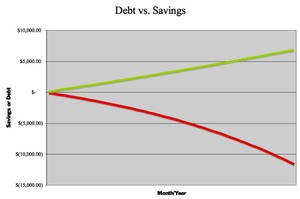
This chart shows what happens to two people. The smart person, we’ll call him Gallant, manages to save $100 a month for five years.
The other one, we’ll call him Doofus, spends $100 more than he has every month.
After five years, Gallant has almost $7,000 in the bank. Even with only 5% interest, he’s building an asset that keeps him out of trouble with his mother-in-law and gives him the freedom to invest in the next part of his business.
The same period of time, Doofus has used his credit cards to finance his debt of $100 a month. That tiny nut has now added up to about $13,000 in 24% credit card debt. And every single month it gets a lot bigger.
If this isn’t interesting to you, consider the company that spends $10,000 or $100,000 extra every month.
A lot of organizations decide to skip the rice and beans and studio apartment step. They decide to "go big or stay home." More often than not, they end up going home.
I spent many years window shopping restaurant menus and driving all night to get to meetings where the plane cost just a bit too much. I thought at the time that I had no choice, but now I realize that I could have borrowed money on my credit cards and lived a little easier. I’m glad I didn’t.
When I talk to people who want to become marketers, I almost always tell them to go start something and go market something. The same advice for 15 year olds and seniors. Turning off the TV and building a Cafe Press store is not only free, but it starts to build a professional-skills asset for the long haul. Pay as much as you need to for things that matter, and as little as you can for things that don’t. And never borrow money to pay for something that goes down in value.
April 30, 2007
Sorry, full!
Friday, May 4, I’ll be trying out some new slides and riffs on the presentation for the Dip. If you’d like to be part of the audience (I need your feedback!), would love to have you stop by the office. Drop me a line, there’s only room for ten or so people (and it’s an off the record, non-public sort of thing). I’ll write back with specifics, timing, etc. Admission is free, no strings, no promises. The focus is going to be on the presentation, so it’s not really a workshop, except in the theatrical sense.
I’ll take this post down once we’re full. Thanks.
Predicting the future of the iPhone is perfect bait for marketing pundits everywhere. How about a pool and we’ll see who’s as smart as they pretend to be?
Steve Ballmer says, "There’s no chance that the iPhone is going to get any significant market share. No chance."
Laura Ries writes,
"I don’t disagree with the prediction that initially Apple will sell
quite a few iPhones. Steve Job’s brilliant job with the PR and the
media’s love of convergence will make an iPhone a must have for some
early adopters and elites.
But shortly after the launch the initial hype will wear off and
Steve will move on to the next project at Apple. Then the iPhone will
end up in the convergence scrap heap along with the ROKR, N-Gage, WebTv
and many others."
Easy to be hard, I guess. My take is quite different. I think the iPhone is going to sell 2 million units in 2007 and more in 2008. There, I said it.
So, I invite you to make a prediction, trackback it here and a year from now, we’ll take a look.
Paul points us to this interview: Inside Business – 29/04/2007: ANZ posts impressive first-half profits.
The money quote:
ALAN KOHLER, PRESENTER: […] Well, John MacFarlane, you’re saying that Asia is hot, which of course it is, and that ANZ is moving early to position yourself there. But you actually moved out early, didn’t you, by selling Grindleys in 2000. In fact Friday is the seventh anniversary of the sale of Grindleys, so doesn’t what you’re doing now in Asia basically represent an admission that that was a mistake?
JOHN MCFARLANE: Everything in its time. If we had not sold Grindleys when we sold it we would not be as successful in Australia and New Zealand as we are today, I can assure you of that.
ALAN KOHLER: Why is that?
JOHN MCFARLANE: Focus is everything in business and Grindleys was a distraction for us. It occupied more than half our management time, more than half our board time and contributed nine per cent of our profits. And it was the wrong part of the world.
April 29, 2007
John pitches in on the Dip from about.com: Podcasting: Radio Reinvented.
I’ve already been profoundly affected by it, if the measure of "profound" is that I’ve begun changing my behavior. Many times while reading through this, I resonated with the idea of knowing when to quit as also being the ability to say no. Not just to specific projects or even people, but to behavior that tends to lead me down a rabbit hole where I don’t get anything accomplished. I’m actually really good at time management (I work from home and had to learn to do so effectively out of self-preservation) but having the idea of ‘the dip’ elucidated so well has really helped me.
Pam points us to Family to Family. This extraordinary non-profit connects communities with plenty to communities without enough.
I’m fascinated by the lack of infrastructure necessary to accomplish this. An all-volunteer group is able to become a clearinghouse, connecting people who need and want to be connected.
 My favorite image of the moment.
This still from my favorite TV show growing up (have you figured it out yet?) represents the imperative that we all have in creating the remarkable, the thing that people consider the best in the world.
The person pointing wasn't paid to do so. He did it because he wanted to.
The people looking aren't looking because they care about Superman. They're looking because everyone else is looking.
As our society gets more connected, it is also getting more fragmented. You can find just about anything online, billions of tiny niches. But the niches that turn a profit are the ones that attract a crowd, that establish themselves as the best in the world. Just another word for remarkable.