All Marketers...
Numbers and pictures

The only kind of lie that’s easier than a numbers lie is a lie with pictures. Here’s an ad that manages to do both.
Read about it here:
Automaker vs. the People: UCS ad response to Automakers
The only kind of lie that’s easier than a numbers lie is a lie with pictures. Here’s an ad that manages to do both.
Read about it here:
Automaker vs. the People: UCS ad response to Automakers
 This is a very popular brand of “soy sauce” for take out chinese restaurants in New York. It’s made not far from my house in White Plains, NY.
The thing is, there’s no soy sauce in it. The ingredients state that it contains water and salt and coloring and “hydrolyzed soy protein.” That, ladies and gentlemen, isn’t soy sauce.
So, why, after paying rent, importing chefs, going shopping, putting up the signs, printing all those menus, cutting all those vegetables, cooking everything and then serving it in clever but expensive take out containers would a restaurant decide to save a penny (and the savings can’t be more than a penny) serving fake soy sauce?
Does the brown color make diners feel like they’re eating something more Chinese than ordinary table salt would? Undoubtedly.
George Atkinson, the founder of the first videostore, just died.
All he did was buy a few videocassettes and a one inch ad in the Los Angeles Times. That and he followed through and persisted and relentlessly changed one multi-billion dollar industry while inventing another.
He didn’t need access to capital or a crystal ball or a fancy network. He just did it.
Could you have done the same thing?
There are 5 million, ten million, a billion blogs.
What are they saying about issues you care about?
What are they saying about you?
Here’s a simple two step way to find out and keep finding out.
Step 1: Visit: Technorati: What’s happening on the Web right now.
At the top, type in your name or your brand or your issue, probably in quotes.
After you do a search, choose to make it a Watchlist.
Technorati asks you to register (it’s free), and then gives you an RSS feed.
Copy that and go over to: Bloglines | My Feeds.
If you’re not a member, you should join.
Now, add the thing you just copied out of technorati and boom, it’s being watched for you.
Every time you go back to bloglines, you can see the latest news about your issues and your brands (and your name), from millions of other sites. For free.
Hey, who invented this Internet thing, anyway?
PS, while you’re over at Bloglines, paste this in:
http://sethgodin.typepad.com/seths_blog/index.rdf
It will give you an automatic update of this blog.
You can also get my Liar’s Blog automatically updated by pasting this in:
http://feeds.feedburner.com/SethGodin-LiarsBlog
Darren Barefoot reveals the most photographed cities (on a per capita basis, as posted on Flickr). Vancouver is on the list because that’s where Flickr started. The rest are each explained in their own way (Amsterdam and Vegas are photogenic, New York has too many people who don’t own digital cameras), and the list has no predictive power whatsoever (try to guess the next one in the series… answer on Darren’s site).
Just because you have access to data doesn’t mean that it’s helpful. More often than not, it (the data, or lack thereof) is just justification to do nothing about truly pressing issues.
Vancouver – 7.94
Amsterdam – 4.69
Las Vegas – 4.03
Seattle – 3.80
San Francisco – 3.16
London – 2.76
Barcelona – 1.99
Sydney – 1.83
Toronto – 1.32
Chicago – 1.31
New York – 1.13
Los Angeles – 0.62Link: The Most Photographed City on Flickr | Darren Barefoot.
Link: Eyetrack III – What You Most Need to Know
This is good stuff.
Thanks to Kpaul for the link.
 So, you’ve decided to go spend a few thousand dollars on clothes. You’re a little heavier than you were last year (it was a rough Christmas) but you’d rather not be reminded of that.
No problem!
One would think that clothes sizing would be a fairly standard system. It’s not. Over the years, as our population has –ahem– expanded, sizes have as well. A women’s size 6 is a lot bigger than it used to be (and a Junior Women’s 3x is hardly junior).
As a result, the shopper can tell herself a lie… a story about both looking good and feeling good. And that’s the whole point of clothes shopping, isn’t it? We don’t need a new outfit, we want one. And shopping for expensive clothes is all about changing the way the shopper feels.
 Why are we spending so much time and money in Congress focusing on a private bill addressed at just one person’s tragic story? It’s certainly not about saving lives–in the same amount of time, Congress could save thousands of lives, not just one. Those lives, however, don’t make good TV.
Congresspeople from both sides of the aisle are falling over themselves to see who can get the most airtime talking about the case of Terri Schiavo. Not because it’s a legislative priority or because the medical facts support their efforts. They’re doing it because it’s a compelling story, a story with a simple, vivid, powerful argument on one side and a more subtle, fact-based analysis on the other.
Because we’re people, not computers, the first kind of story usually wins.
Regardless of your point of view about the issue, the marketer in us has to acknowledge that this is all about the story. It usually is.
Why do so many people (especially some of the suburban moms I know) hate minivans?
A minivan gets better mileage, is safer and is easier to manage for shlepping a bunch of humans. And dollar for dollar, a minivan is actually cheaper than an SUV of the same size.
So if it’s better and safer and cheaper… why hate em?
Because of the story, of course. Somewhere along the way, we believed a lie about the personality of the person who chooses to drive a minivan. The soccer mom lie. A simple story that cost Detroit billions of dollars–and our economy billions in lost gas mileage.
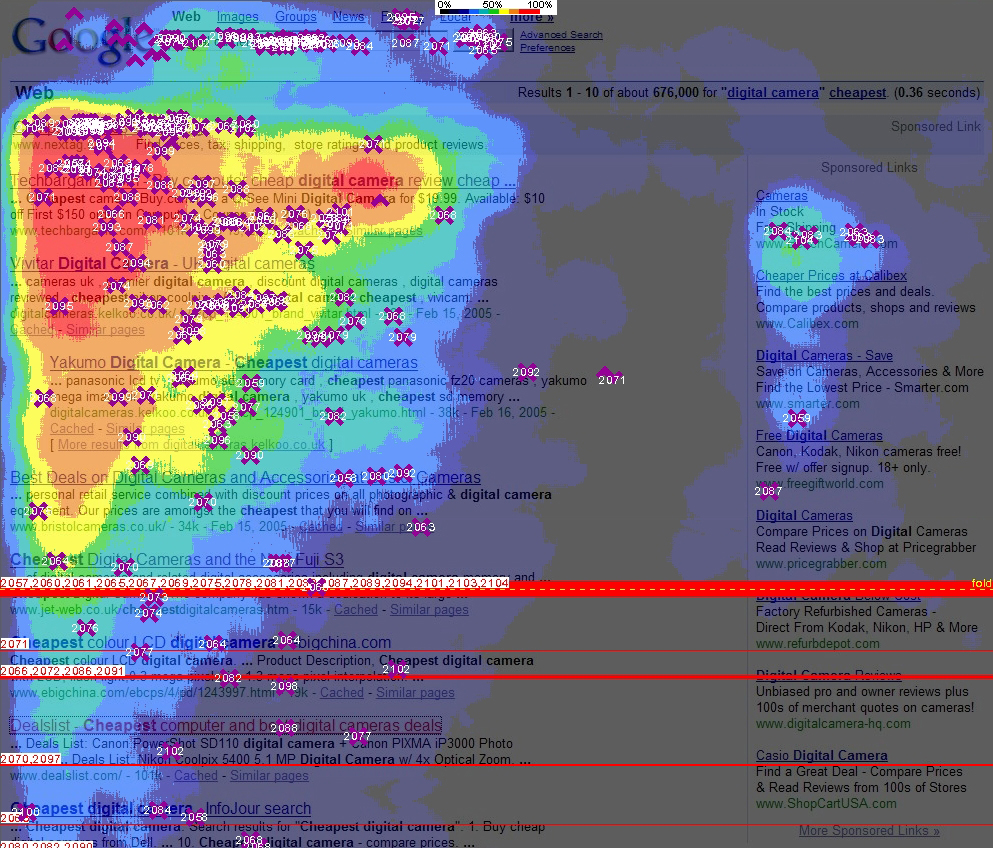
This is how people look at search results:

It’s not a theory, it’s all sorts of fancy science put to good use. And yes, my headline is a pun.
Think about this the next time you want to save a few shekels on where you show up on the screen.
Now that we’ve trained people to read Google pages this way, they probably read your site the very same way.